Flights of Fancy: L.A.’s Air Travel-Inspired Roadside Novelty Buildings

It was a veritable juggernaut—the number and variety of roadside novelty (“vernacular,” “programmatic,” or “mimetic”) buildings that once dotted the urban landscape in Los Angeles.  Like the examples featured in an related earlier post, these “hey-you-can’t miss-me!” buildings were made to pull automobile drivers right off the road—to eat, shop, or stay the night. Quirky, sassy, humorous, and often just crude in design (I mean, a giant pumpkin??)—these whimsical oddities were an important part of the burgeoning American car culture here in Los Angeles and across the entire U.S.A. If this is a topic that fascinates you as much as it fascinates me, then let me refer you to the best book ever written on the subject—local author Jim Heimann’s California Crazy and Beyond: Roadside Vernacular Architecture (2001). You can usually find a copy on Amazon—and it is well worth it! The book is filled with hundreds of vintage photos and pages of well-researched text and is fun to read. But I digress . . .
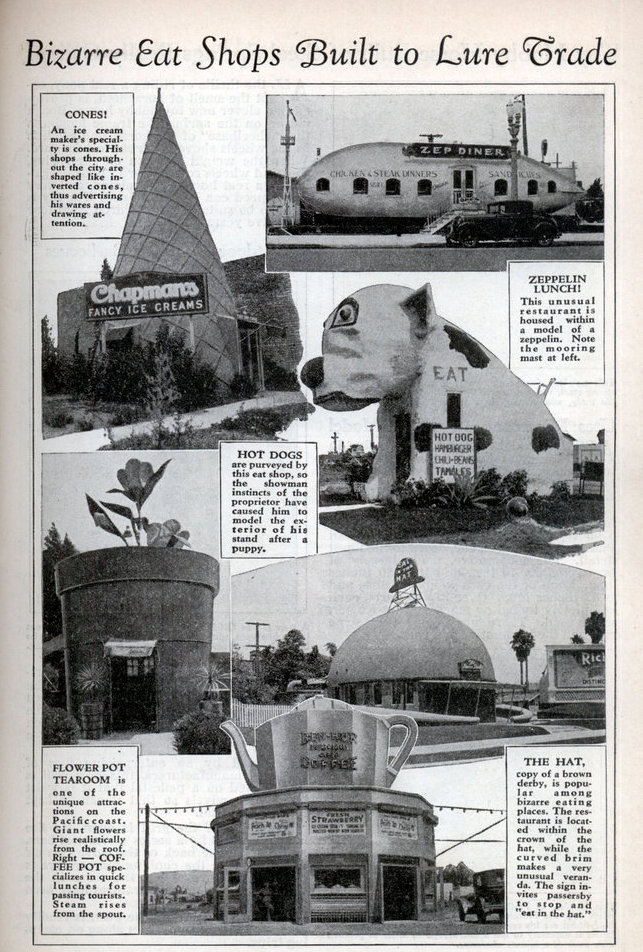
According to Heimann, the “golden age” of programmatic architecture spanned a period of ten years, from 1924-1934. During that time, the bulk of these quirky roadside buildings cropped up all around Los Angeles and cities beyond. Some of those took their architectural theme from the new and exciting concept of air travel. Some of these were:

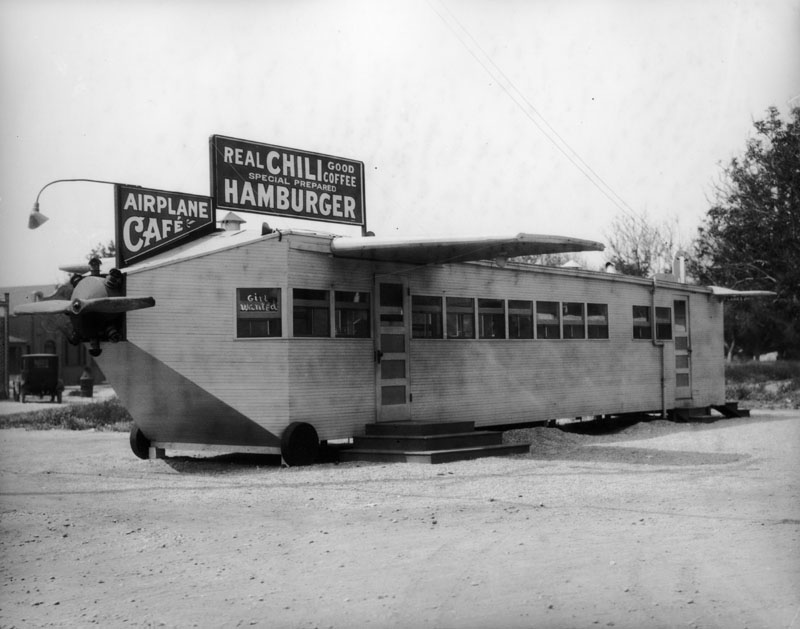
 . . . the Airplane Cafe (c. 1924): Once located on Ventura Boulevard in the San Fernando Valley (exact address unknown), the Airplane Cafe was designed in the shape of a plane, complete with wheels, wings, and a propeller. The structure sat on raised slabs of wood.
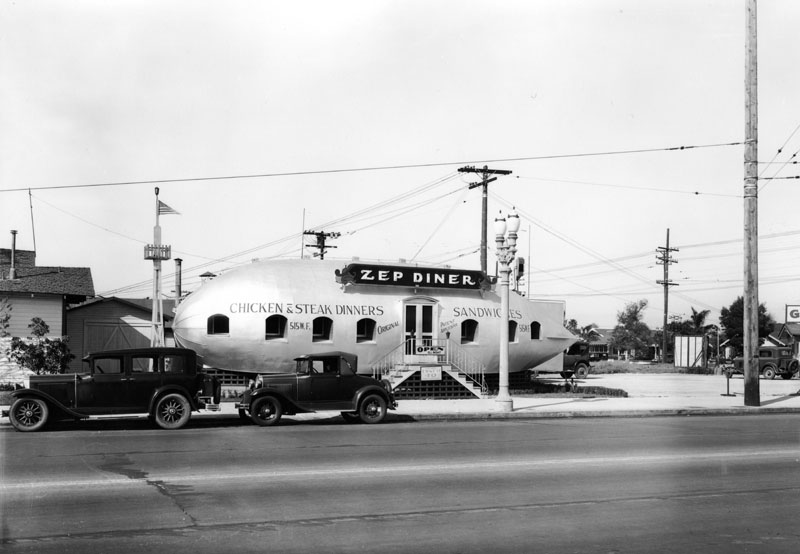
. . .  the Zep Diner (c. 1928): Located at 515 W. Florence Avenue near Figueroa, the Zep Diner was part of the airship craze of the 1920’s and 1930’s. It was open 24 hours and was home to the “Hinden burger.”
. . . and then there was The Dugout (c.1927): This sandwich stand was located at 6157 E. Whittier Boulevard in Montebello and featured a simulated plane crash and sandbagged trenches evocative of World War I.
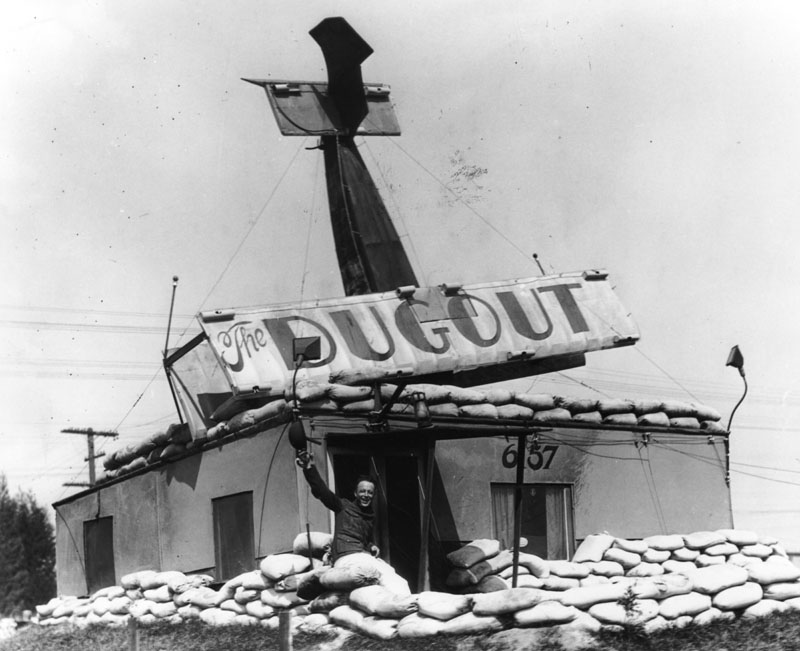
These buildings are long gone, but thank goodness their whimsicality will live on in vintage photos like these!

PICTURE THIS: Remembering Burbank’s Great Pumpkin Building

Years ago I found this image in a box of old family photos. It was undated, unlabeled, and probably taken to show off my grandparent’s new car. But the star of the picture for me was the gigantic pumpkin building in the background. It was one of those roadside oddities (often referred to as “vernacular” or “programmatic” architecture) that once dotted the Southern California urban landscape—but where was it located? And was it still there?

Turns out the self-proclaimed “world’s largest pumpkin” was once located in Burbank’s Magnolia Park business district—steps away from the corner of Hollywood Way and Magnolia Avenue. (The exact address was 3611 Magnolia. If you are familiar with the area, the great pumpkin would have been situated directly across the street from the current Porto’s Bakery, which I highly recommend, lol). Seems that the building started out in 1927 as a nightclub called the “Pumpkin Palace.”

The Pumpkin Palace survived a fire on opening night only to later change hands and personalities many times . . . becoming, among other things, a beer garden and a café. From 1935 until at least 1938, it operated as the Valley Gospel Center. In the 1950’s, the rotund structure was turned back into the Pumpkin Inn, then a real estate office, and by the time of my family’s photo, it was operating as the Magnolia Park Hardware store . . . and (judging by the “for sale” sign in the lower right corner of that picture) was on the market again.

After that, the information trail runs cold, so if anyone out there knows more about the history of Burbank’s great pumpkin building, please feel free to comment. I’d love to know more about its story . . . like when was it finally demolished?

Today, of course, Burbank’s great pumpkin building is long gone—along with its actual street address. I recently took the photos below . . .  the pumpkin would have stood behind the large tree in the center of the top picture. Now the plain exterior wall of a much larger building simply masks the spot. That’s progress, of course.

Palm Springs Celebrates Its Biggest Tribute to Marilyn Monroe Ever!

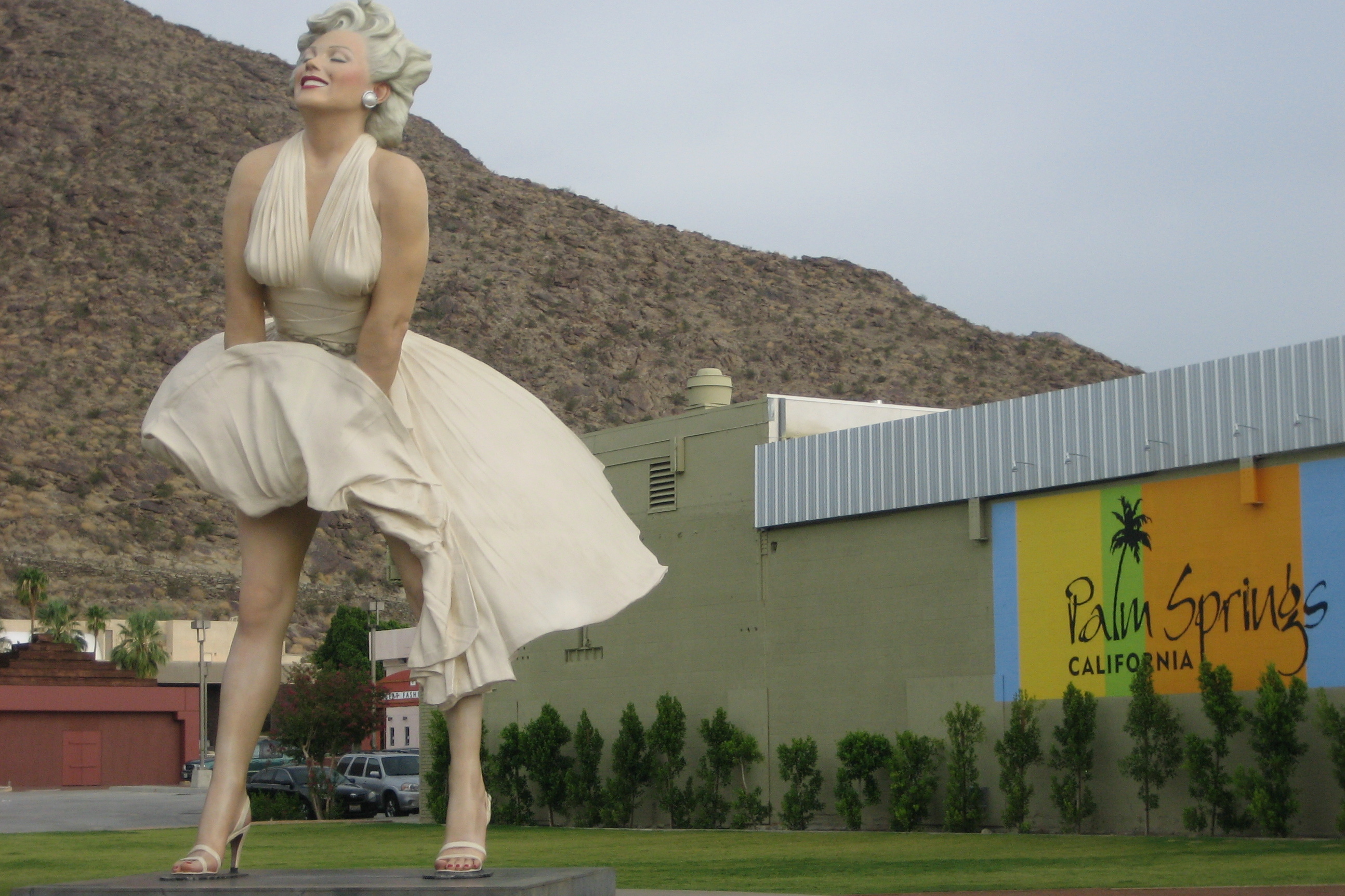
She’s big, blonde, beautiful, and boldly sculpted in that iconic white-dress-flying-up moment from The Seven Year Itch (1955). She’s “Forever Marilyn,” the dramatic creation of 80-year-old American artist Seward Johnson (Johnson and Johnson Company heir). This Marilyn is 26 feet tall and poses at the corner of “Main and Main” (Palm Canyon & Tahquitz Canyon Way) in downtown Palm Springs. You simply cannot miss her.

Seward’s sculpture was inspired by celebrity photographer (and, later, Palm Springs resident) Bill Kobrin’s iconic publicity shot of Marilyn Monroe—holding her skirt down over a New York subway grate—for 20th Century Fox Studios. The statue is made of bronze and stainless steel, and weighs 34,300 pounds. After spending its debut year in Chicago, the massive sculpture was shipped in pieces to Palm Springs. Installation of the exhibit was completed in late May, 2012. This larger-than-life Marilyn Monroe is now the focal point—day and night—on the busy desert boulevard. And everyone—and I do mean EVERYONE (locals and tourists alike)—stop by to take lots of photos!

Marilyn Monroe had many ties to Palm Springs. After all, the city’s early popularity as a getaway spot was the direct result of the Hollywood studios’ “two hour rule”—which dictated that actors under contract had to be available within a two-hour radius of the studios for any last-minute photo or film shoots. Beginning in the late 1920’s, the Hollywood crowd headed to the desert for relaxation.

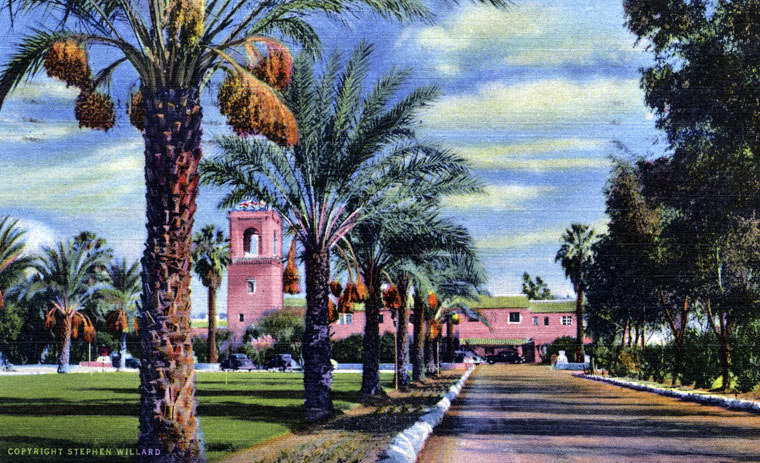
Sparkling swimming pools, tennis courts, bars and restaurants at the El Mirador Hotel (opened 1927) and actor Charlie Farrell’s Racquet Club (1933) were all hot spots. Many of these celebrities later built their own vacation homes in nearby neighborhoods, like the still-chic Las Palmas area.

El Mirador Hotel, c. 1927. (linen postcard)

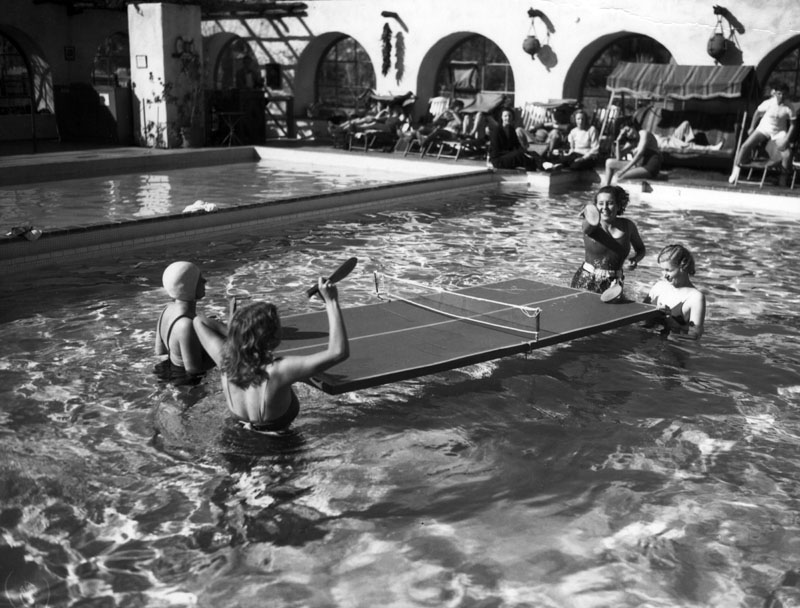
It is Hollywood lore that the young Marilyn Monroe was discovered poolside at the Racquet Club during a 1949 photo session. (Sadly, little remains of the Racquet Club or the El Mirador Hotel.)

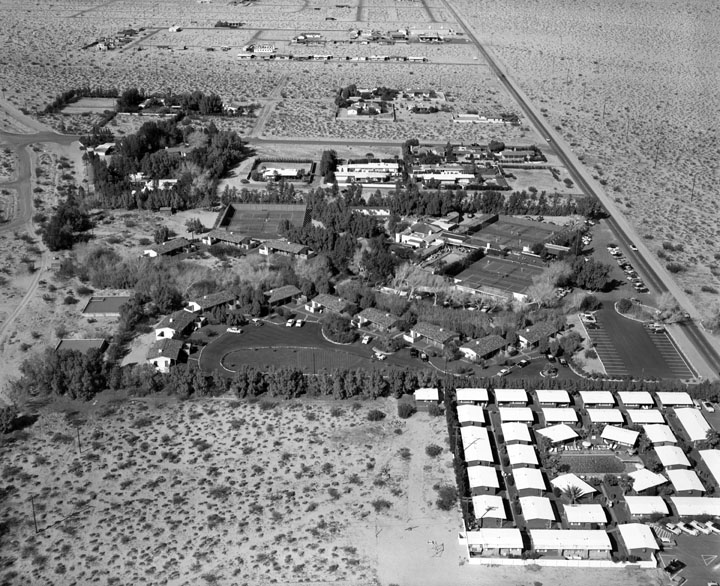
Aerial view of the Racquet Club, Palm Springs, c. 1955.

Later in her career, the uber-famous Marilyn Monroe would often return to her own private Palm Springs home for a break from the pressure of Hollywood stardom.

The “Forever Marilyn” sculpture will hold court in Palm Springs until June, 2013. It’s worth a visit, especially as the temperatures begin to cool. The day I took these photos it was extremely hot and sultry . . . just perfect for a Marilyn sighting!


L.A.’s Exotic Yamashiro: Hollywood History with a Spectacular View

It is definitely one of L.A.’s most historic and unique restaurants. Popular, sophisticated, cool, and utterly atmospheric, Yamashiro has been a local dining treasure for decades. Its public gardens and view-struck Pagoda Bar alone is worth a visit—all in all, an amazing spot to take in distant Pacific Ocean sunsets or the sparkling blanket of L.A.’s city lights after dark.

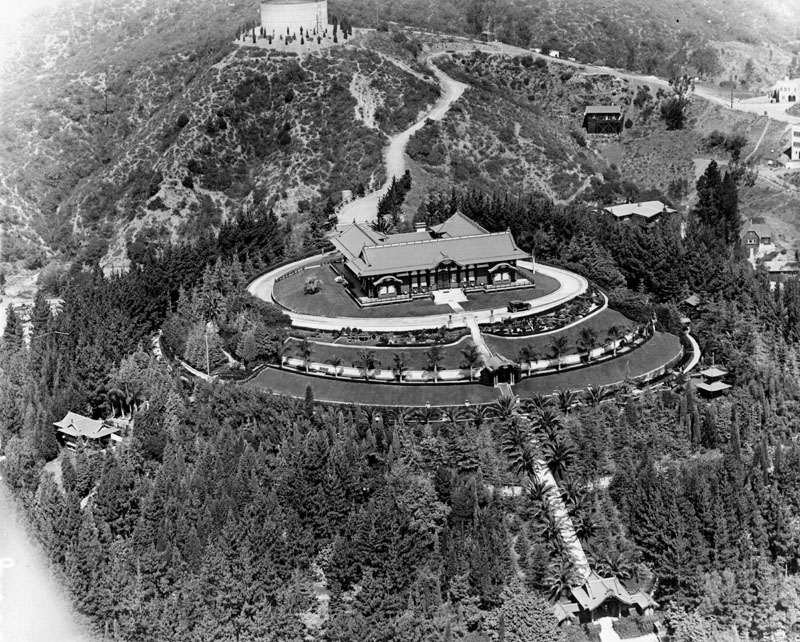
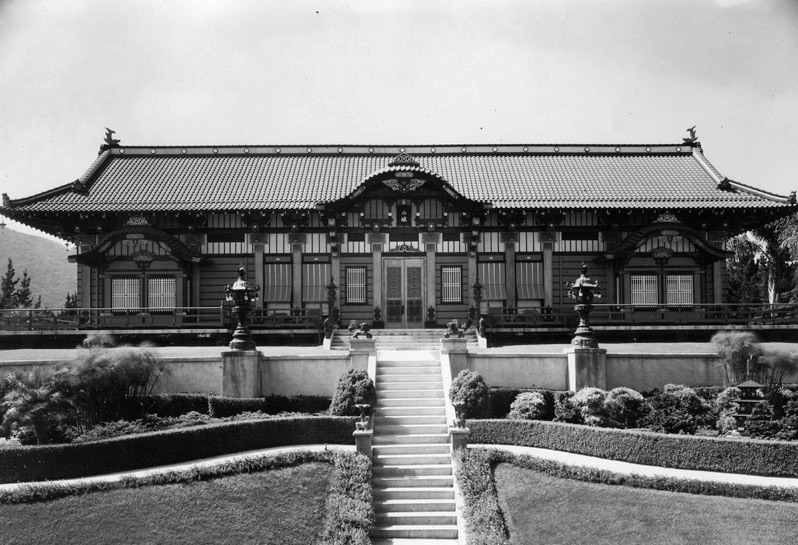
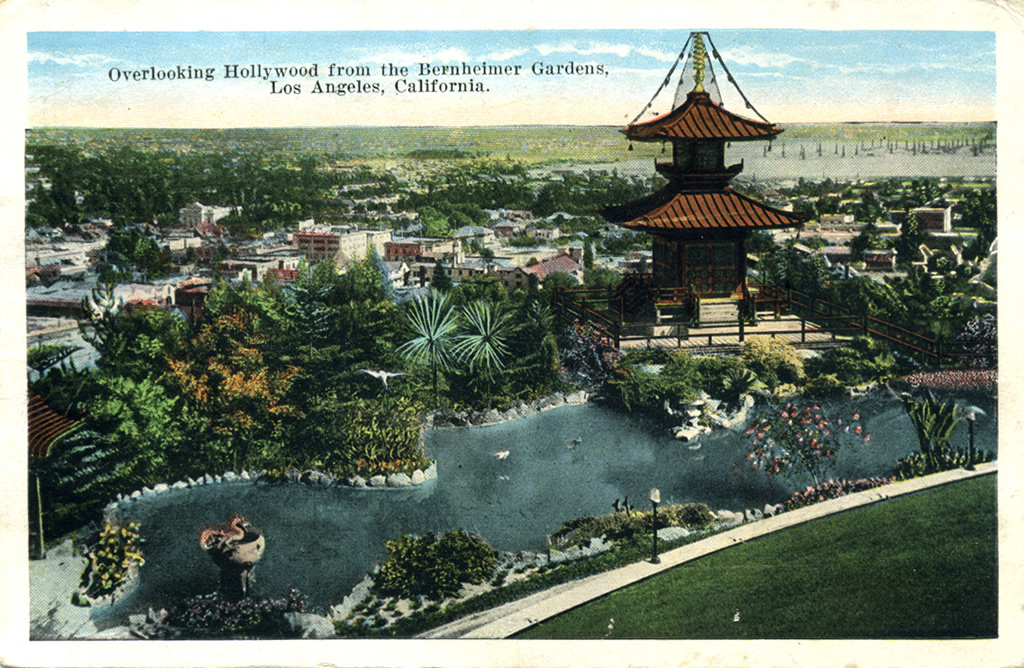
But this is not a restaurant review. Because it is Yamashiro’s first incarnation—as the private and quirky Hollywood Hills residence of Charles and Adolph Bernheimer—that really fascinates me. Old postcards and vintage photographs portray their original hilltop estate, designed in 1911 and completed in 1914.

Bernheimers’ Hollywood estate, c. 1925.

It was the Bernheimer brothers’ dream to create an exact replica of a palace they had seen while traveling in the Yamashiro Mountains near Kyoto, Japan. (“Yamashiro” is the Japanese word for “mountain palace”). Their exotic mansion was built high above Hollywood Boulevard on a seven-acre lot (back when land in the fledgling city was cheap and plentiful).  It was their home, but also a place to exhibit their priceless collection of Asian treasures.

The Bernheimers brought hundreds of skilled craftsmen from the East to build the ten-room teak and cedar main house. Its design was accented with carved rafters lacquered in gold and tipped with bronze dragons. Surrounding Japanese gardens were landscaped at a cost of nearly $2 million, and included hillside terraces covered with 30,000 varieties of trees and colorful plants. The grounds were dotted with waterfalls, streams, ponds loaded with goldfish, and even a private zoo that was home to exotic birds and monkeys. There was even a miniature Japanese village that featured tiny houseboats floating through a maze of little canals.

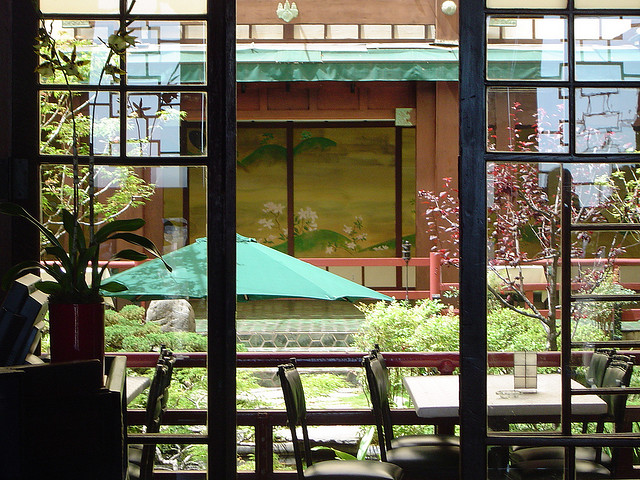
Major focal points included the 300-step stairway leading up the steep terraced hillside gardens to the main house, a 600-year-old stone pagoda imported to stand beside a lake filled with black swans, and the Sacred Inner Court. The court formed a lovely interior garden at the center of the mansion. It was filled with fish ponds and provided light and air to the surrounding rooms, which had walls covered in tapestries and silk.

In 1922, one of the Bernheimer brothers died and most of the Asian treasures were auctioned off. However, the residence became a popular gathering spot for the Hollywood elite, such as Lillian Gish, Ramon Navarro, Charlie Chaplin, and a host of other actors, directors, writers, and movie-industry folk. The Bernheimers’ hilltop retreat became an integral part of Hollywood’s Golden Age.

The property survived the Great Depression and the World War II years, but ultimately suffered from vandals and years of deterioration. In 1948, and on the verge of demolition, the estate was purchased by businessman Thomas O. Glover. He planned to tear down the Bernheimer house and build apartments, but instead decided to restore the building once old architectural treasures came to light.

Over the years, the Glover family continued the restoration and renovation process, while creating the Yamashiro dining location that locals love to brag about. (Today, the old stone pagoda stands next to a modern swimming pool, the Inner Court is used for dining and weddings, and the colorful hillside gardens are available for public touring.)

Yamashiro and its public gardens are located at 1999 N. Sycamore, Hollywood. It has been a Los Angeles Historic-Cultural Monument since 2008.